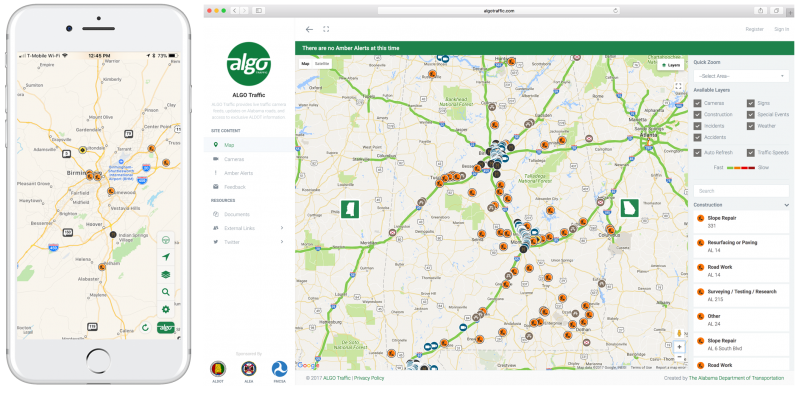
Algo Traffic was developed by CAPS under the joint sponsorship of Alabama Department of Transportation (ALDOT) and Alabama Law Enforcement Agency (ALEA) through funding from the Federal Motor Carrier Safety Administration (FMCSA). Algo Traffic provides updates on Alabama road and exclusive ALDOT information to its users, including live traffic camera feeds, message sign readouts, incident and construction information, and current road congestion levels.
Users have the ability to create a profile and sign up for push notifications, email alerts, and live camera feeds for their daily commute. Algo Traffic keeps users informed about active alerts for the state, and lets users select “driving mode” to be notified of upcoming events on their route.
Algo Traffic currently supports Birmingham, Mobile, Montgomery, Tuscaloosa, and Huntsville, with more locations coming in future phases.
eSearch is an administrative website that has been developed to be used in conjunction with eCite. Court clerks and magistrates are given access to the site to view tickets, print tickets, mark the status of tickets, view the case associated with that ticket, and search by court date among other things. There are various search fields that enable court personnel and to ascertain a tremendous amount and array of information instantaneously.
eSwear is a virtual swearing process that allows the officer to swear to the authenticity of the ticket and the clerk to confirm via a touch-screen kiosk. We believe Alabama is the first state to implement such a system. eSearch is used in conjunction with eSwear but eSearch can also be used for courts that do not have the eSwear system.
These programs were developed in cooperation with the Alabama Administrative Office of Courts.
Mobile Officer Virtual Environment (MOVE) was developed for officers to use on laptops in their cars, not on a desktop in the office. It was designed to combine the officer’s critical software tools onto one screen and for them to work together seamlessly.
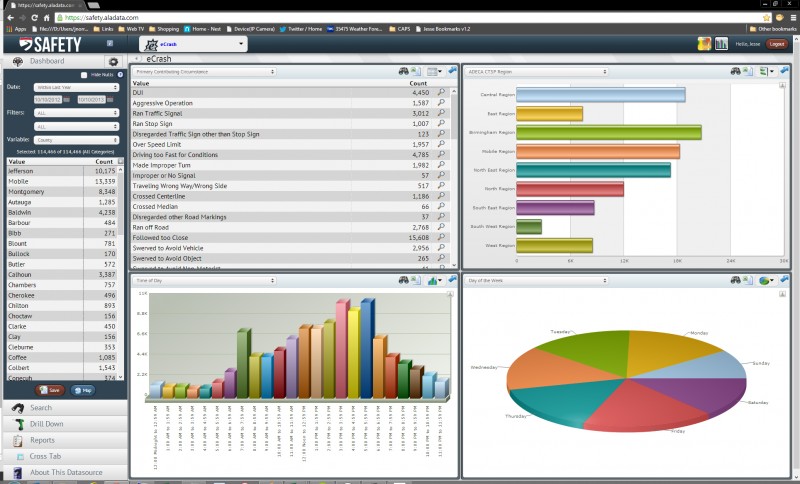
SAFETY is a powerful web portal dashboard that allows users to analyze and visualize electronic data in a variety of ways.
This dashboard is designed specifically for traffic safety professionals. It contains crash data including location information and is individually password protected for use by official traffic safety personnel.
eCrash is an electronic traffic crash reporting and transmission procedure system.
The eCrash system, like eCite, is a process-level solution to the outdated and time-consuming paper crash report form used by law enforcement and the court system. Crash reports generated through eCrash are quick, accurate, secure, and legible.
eCrash is more than a form. The development of eCrash began as a workflow solution for Alabama law enforcement’s processing of over 130,000 traffic crash reports annually. It was solidified after the state’s decision to require MMUCC compliant reports. CAPS, therefore, developed the eCrash system as a means of collecting, cleaning, and analyzing data and making that data easily accessible by all involved agencies
eCrash enables law enforcement to prepare MMUCC-5 compliant crash forms 100% electronically.
eCrash is utilized by officers in the field to document traffic crash reports and transmit the data to a server repository. Officers use the same equipment (scanner combined with a laptop, notebook or tablet PC) and software environment (MOVE) for both eCrash and eCite.
A full suite of administrative tools is available through MOVE to support the needed backend processing of crash forms and the approval and archiving of the crash data.
Overview Video
Coming Soon
Features & MOVE Integration
Driver’s license scanning (reads all 50 states)
Auto-Population of DL and GPS information
Integrates with crash diagramming applications, such as Easy Street Draw and ScenePD
Crash Report Validation to minimize errors + MMUCC 5 compliant
Eliminates redundant data entry
Improved timeliness of data
Electronic submission allows for paperless system + Web portal for supervisor approval of crash report + Web portal for analysis
Windows 7 or later compatible
Access to searchable LETS data
Find the current officer’s GPS location
Transfer the record and submit it for supervisory approval
Correct any faults in the record found by supervisors
Print the record at the roadside
Includes crash location functionality and crash diagram support
Design & Technology
eCrash transformed a major hurdle of crash data reporting by enabling the entry of crash data as close to the crash scene as possible. The eCrash system provides full-scale consistency and fewer interpretation errors in crash data.
An effortless and uncomplicated design was important to project partner, Alabama Department of Public Safety, and resulted in the following design features:
Individual reports customized to reflect any number of involved drivers, units, persons, pedestrians, or other non-motorists
Required report sections remain highlighted in red until complete
Data elements are tracked and a validation check prevents the report from being submitted with incomplete data
Electronic submission reduces duplicate efforts and provide immediate access to report data
The eCrash system was developed concurrently with Alabama’s initiative to change to MMUCC-compatible crash reports. MUCC, a voluntary data collection guideline, was developed in 1998 by the National Highway Traffic Safety Administration (NHTSA) and the Governors Highway Safety Association (GHSA) to encourage greater uniformity. The MMUCC guideline identifies a minimum set of motor vehicle crash data elements and their attributes that States should consider collecting and including in their State crash data system. The current version of eCrash is compatible with MMUCC-5, the most current version of the guideline.
I Want eCrash
Inquiries
eCite can be adapted for any state or municipality. If you are interested in implementing eCite, another CAPS product, or working with CAPS on a custom solution, we want to hear from you!
Training Manuals
An eCrash User Guide and an eCrash Data Element Training Manual are available upon request for eCrash users. Direct requests to: care@cs.ua.edu.
The Critical Analysis Reporting Environment (CARE) is a data analysis software package originally designed for problem identification and countermeasure development in traffic safety applications.
It uses advanced analytical and statistical techniques to generate valuable information directly form data.
Using CARE’s step-by-step on screen menus, it is easy to turn data into enlightening information.
CARE provides:
descriptive statistics
information mining
geographical information system access
roadway engineering support
dashboard support
CARE’s dashboard support includes access to real-time statistics on key law enforcement systems including:
traffic citations
crash reports
criminal incident reports
other critical systems for which we have developed field data capture software
Dashboards have been deployed for:
police agencies
traffic engineers
traffic safety stakeholders
While its primary use is for traffic safety, CARE can be used to process any database including:
emergency medical services
medical data
nursing data
questionnaires
criminal justice
The CARE software for traffic safety applications is available free of charge. In order to take full advantage of CARE, existing data must be converted into a CARE dataset. In the case of a state, initial state CARE data sets can be created by having the state’s current database read by CARE’s Extract=Translate-Load (ETL) to produce the various CARE datasets that form the CARE warehouse. CAPS can create the initial state CARE dataset for your state for a reasonable fee. Contact Us.
The CARE software exists in both a desktop version for Windows OS and a Web version. CARE can be downloaded here or installed from a CD. Additionally, some highway safety CARE capabilities are also available online at the CARE Online Analysis site.
CARE is an award-winning program:
NHTSA 1995 Administrator’s Public Service Award
Runner-up for the 2015 ATSIP Best Practice Award.
Using the CARE program will undoubtedly assist the traffic safety program of any organization that chooses to use it.
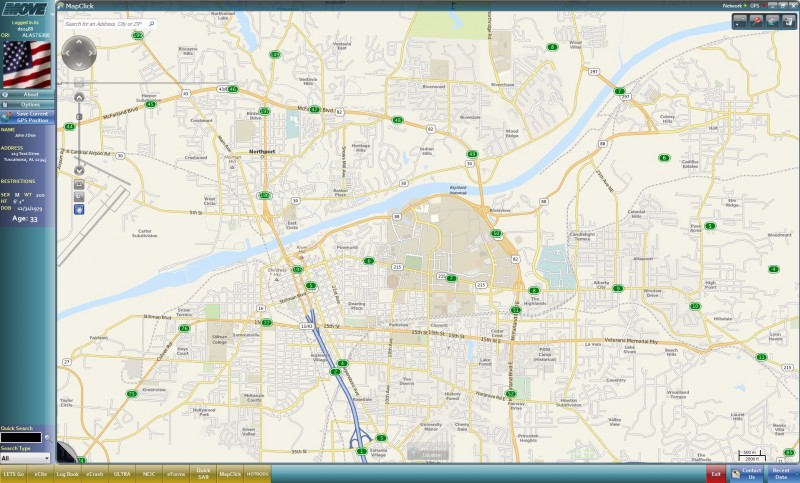
MapClick is a mapping application that is integrated into the MOVE framework. Location information from MapClick is stored in Move as objects that can be populated into eCite, eCrash or any of the applications residing in MOVE.
It has multiple layers for coordinates, node numbers, link numbers, road names, road codes and milepoints. With the layers tool, users can get details about layers, toggle between them, and turn them off.
Users can click a spot on the map and be provided with the two nearest nodes, the GPS coordinates,and an address. The user can populate this information into the various MOVE applications.
MapClick works independently, with an internet connection, or when paired with a GPS device:
independently: using location information stored within the program
internet connection: adds real-time location information from Google
GPS device: enables tracking, which shows the user’s car on the map and saves the current location
Cite is an Electronic Citation Generation and Processing System.
It was developed as a process-level solution to the outdated and time-consuming paper citation form used by law enforcement and the court system. Citations generated through eCite are quick, accurate, secure, and legible.
eCite is more than a form. The vision for eCite was born out of the needs of the court system for timely and secure access to accurate citation data, but citation data was originated by law enforcement. Therefore, CAPS developed the eCite system as a means of collecting, cleaning, and analyzing data and making that data easily accessible by all agencies involved.
The eCite system is fully integrated into the Mobile Officers’ Virtual Environment (MOVE) and is not offered as a stand-alone product.
Process
eCite enables the entire citation process, from citation issuance to transferring citation data to the district court system, to be completed 100 percent electronically. NO hand-entered data!
The multiple users, interfaces, equipment, and state legislation involved this process solution illustrates CAPS’ integrated systems approach to software design and problem-solving.
eCite is utilized by officers in the field to issue tickets, print a copy for the violator, and transmit the data to a server repository using a laptop, notebook, or tablet PC.
eCite improves an officer’s safety and efficiency by enabling faster citation issuance, reducing exposure to a potentially dangerous defendant, and the ability to validate a defendant’s identity and view their previous records. Redundant paperwork is eliminated through an integrated activity logbook. These factors allow officers to spend a greater percentage of their shift in patrol and results in increased job satisfaction.
Law enforcement and court system personnel access officers submit data through CAPS developed administrative portals, eSwear, eSearch, and Advance.
The suite of administrative tools supports the electronic filing of citations with the court system, as well as the backend processing and archiving of the citation data.
eSwear is a virtual swearing process that allows the officer to swear to the authenticity of the ticket and the clerk to confirm via a touch-screen kiosk equipped with biometric-based authentication.
eSearch enables clerks and law enforcement administrators to search, access, and evaluate existing citations. Citations can be printed from this site as needed.
ADVANCE is a web portal dashboard enabling users to analyze and visualize data.
CAPS provides free, secure web services for law enforcement and court personnel to pull data collected in eCite into their records management systems (RMS) and court case management systems (CMS) respectively.
Overview Video
Features & MOVE Integration
Auto-populates citation data from driver’s license barcode and magnetic stripe scanning (MOVE integration)
Auto-populates driver’s license information (implemented by LETS-GO)
Auto-populates certain form fields with setting defaults (e.g., county, court, etc.)
Auto-populates driver and/or vehicle data from third-party applications (ASPEN*, etc.)
Auto-populates location data from GPS device
Interfaces with web pages and other applications through MOVE
Automated data validation (checks for consistency and completeness)
Citation replication (simplifies & speeds the writing of multiple offenses)
Defines screen templates for customized preset values
Automated, internet-based upload of ticket data to central data repository
Automated, internet-based download of ticket numbers from a central repository
Writes and tracks warning citations
Transfers data from eCite into officer’s daily activity log through MOVE
* ASPEN is a FMCSA software for federal electronic reporting of commercial vehicle violations Learn more about MOVE
Electronic Solution
Issuance: via the eCite software on laptops in the officer’s vehicles
eTransmittal: once Internet connectivity is established via cellular air cards or hot spots
eSwear: via a computer kiosk at the clerk’s office
eFiling: via the integrated network – no mailing of hard copies
ePayments: via credit card over the internet
eSearch and statistical analyses: via secure password-protected web portal
I Want eCite
Alabama Agencies
eCite is free of charge to Alabama law enforcement agencies.
New users must complete initial forms that include providing the municipal court information and municipal adopting codes. This information is necessary to customize the software before you can begin using it. User accounts will be set up for agency officers.
Training manuals are available upon request: email care@cs.ua.edu
Inquiries
eCite can be adapted for any state or municipality. If you are interested in implementing eCite, another CAPS product, or working with CAPS on a custom solution, we want to hear from you!
Training Manuals
Available upon request to eCite users. To request a manual, please email care@cs.ua.edu.
This study was conducted at the request of an advocate group that wanted information to assist them in developing public information and education countermeasuers for teen-age drivers. While most past CAPS studies of youth-involved drivers were limited to 16-20 year olds, the advocate group was also interested in 15 year olds, and they were not interested in 20 year olds since their projects were oriented around teen drivers. Several studies were conducted, including CARE IMPACT studies that compared 15, 16-19 and 15-19 year old causal drivers with causal drivers in the older age group.
This was a recent report requested to provide information for the Distracted Driver Summit held at UAB on December 3, 2009. A variety of driver distraction causes are discussed and compared.